

Recently, sun Haiding and long Shibing of the Institute of microelectronics of the University of science and technology of China made a breakthrough in the important progress of UV LED luminescence performance by using sapphire substrate to regulate the three-dimensional carrier confinement of quantum wells. Relevant research was published in advanced functional materials under the title of "unambiguably enhanced ultra violet luminescence of AlGaN wavy quantum well structures grow on large misiered sapphire substrate1".
Although ultraviolet energy accounts for only 5% of sunlight, it is widely used in human life. At present, UV light applications include printing and solidification, coin anti-counterfeiting, skin disease treatment, plant growth and illumination, destroying the molecular structure of microorganisms such as bacteria and viruses, so it is widely used in air sterilization, water purification, solid surface sterilization and other fields. The traditional UV light source generally uses the excited state of mercury vapor discharge to produce UV light, which has many defects, such as high power consumption, large heat generation, short life, slow reaction, safety risks and so on. The new type of deep UV light source adopts the principle of light emitting diode (LED), which has many advantages over the traditional mercury lamp. The most important advantage is that it does not contain toxic mercury. The implementation of Minamata convention indicates that the use of UV lamps containing mercury will be banned in 2020. Therefore, the development of a new environmental protection, efficient UV light source has become an important challenge in front of people.
The deep ultraviolet LED (DUV LED) based on the wide band gap semiconductor material (Gan, AlGaN) has become the only choice for this new application. This all solid-state light source system is small in size, high in efficiency and long in life. Just a chip the size of a thumb cover can emit more ultraviolet light than a mercury lamp. The secret lies in the direct band gap semiconductor material, group III nitride: electrons in the conduction band combine with holes in the valence band to produce photons. The energy of photons depends on the band gap width of materials. Scientists can precisely achieve different wavelengths of luminescence by adjusting the element composition of AlGaN. However, it is not always easy to realize the efficient emission of UV LED. The researchers found that when electrons and holes are combined, photons are not always generated. This efficiency is called internal quantum efficiency (IQE).
Sun Haiding and long Shibing, Professor of the Institute of microelectronics, University of science and technology of China, cleverly adjust the bevel angle of sapphire substrate, greatly improve the Iqe and device luminous power of UV LED. The research team found that when the substrate angle was increased, the dislocations in the UV LED were obviously suppressed, and the luminous intensity of the device was significantly increased. When the substrate reaches 4 degrees, the intensity of the device's fluorescence spectrum increases by an order of magnitude, and the internal quantum efficiency reaches more than 90% of the record.
Different from the traditional UV LED structure, the thickness of the potential well and barrier in the inner luminescent layer of the new structure, MQW, is not uniform. With the help of high-resolution transmission electron microscope, researchers can analyze the quantum well structure with only a few nanometers at the micro scale. The results show that the Ga atoms will gather at the substrate step, which leads to the local energy band narrowing. With the growth of the film, the GA and Al rich regions will extend to the surface of DUV led, and twist and bend in the three-dimensional space, forming a three-dimensional multi quantum well structure. Researchers call this special phenomenon: phase separation and carrier localization of Al and GA elements. It is worth pointing out that in and GA are not 100% mutually soluble in the blue LED system based on InGaN, which results in the area rich in in and GA in the material, resulting in the local state, promoting the radiation recombination of carriers. However, the phase separation of Al and GA is rarely seen in the AlGaN system. One of the important significance of this work is to adjust the growth mode of materials artificially, promote phase separation, and thus greatly improve the light-emitting characteristics of devices.
By optimizing the epitaxial growth regulation on a 4-degree chamfered substrate, the researchers found an optimal duvled structure. The carrier lifetime of the structure is more than 1.60 ns, which is generally less than 1 ns in traditional devices. Further testing the chip's light-emitting power, the researchers found that its ultraviolet light-emitting power is two times stronger than the traditional device based on 0.2-degree oblique cutting angle substrate, as shown in the figure. It is more certain that AlGaN materials can achieve effective phase separation and carrier localization. In addition, the phase separation in AlGaN multiple quantum wells and the influence of the thickness heterogeneity of potential well and barrier on the luminous intensity and wavelength are simulated by theoretical calculation, which is in good agreement with the experiment.
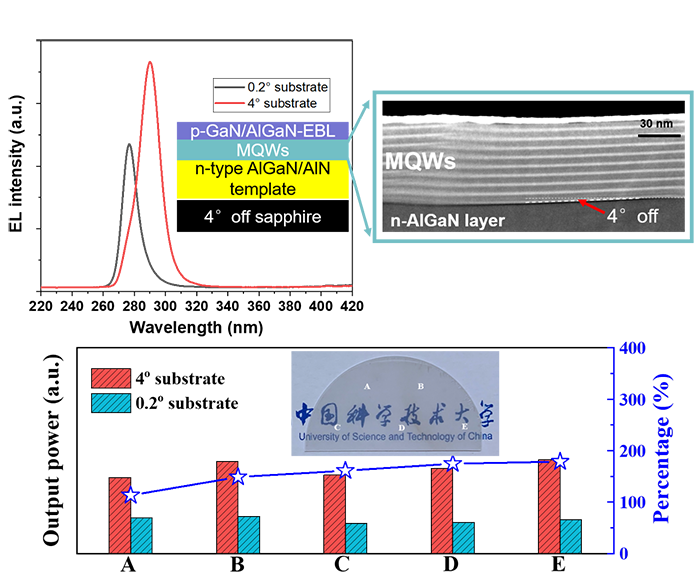
Fig.: deep UV LED photoluminescence spectrum and device schematic diagram prepared on 0.2 and 4 degree bevel angle sapphire substrate. The active area transmission electron microscope shows the high-resolution multi quantum well structure diagram and the comparison diagram of output power.
This research will provide new ideas for the research and development of all solid-state UV light source with high efficiency. This method does not need expensive patterned substrate or complicated epitaxial growth process. However, only by adjusting the substrate angle and matching and optimizing the epitaxial growth parameters, it is expected to improve the luminous characteristics of the UV led to a level comparable to that of the blue LED, which will lay the experimental and theoretical foundation for the large-scale application of the high-power deep UV LED.
Researcher sun Haiding from the College of microelectronics, University of science and technology of China is the first author and co corresponding author of the paper. The project was completed jointly with Guo Wei and ye Jichun, researchers of Ningbo Institute of materials, Chinese Academy of Sciences, Dai Jiangnan and Chen Changqing, professors of Huazhong University of science and technology, Zhang Zihui, Hebei University of technology, boon Ooi and Iman roqan, Professor of King Abdullah University of science and technology, Saudi Arabia. The research work has been supported by NSFC, Chinese Academy of Sciences, Chinese University of science and technology and other units. Part of the sample processing technology was completed in the research and manufacturing center of China University of science and technology.
Paper link: https://onlinelibrary.willey.com/doi/full/10.1002/adfm.201905445
(College of information science and technology, scientific research department)