

Recently, Professor Xu Xin's research group of School of chemistry and materials science of University of science and technology of China has prepared light concrete with self-cleaning, super hydrophobic, high porosity, heat insulation and sound insulation by a simple method. Relevant research was published on ACS Applied Materials & interfaces under the title of "simple fabric of concrete with removable self-cleaning capability, robust superhydrobiology, followed poverty, and high thermal and sound insulation".
The implementation of building energy conservation and environmental protection is one of the keys to the formation of green development, circular development and low-carbon development. Lightweight concrete has received more and more attention in the field of external wall insulation. It can reduce the heat loss and replace the traditional organic foam to achieve the effect of fire prevention. It is estimated that by 2022, the market scale of external wall thermal insulation materials in China will exceed 200 billion yuan. With the improvement of people's living standard, single insulation performance can not fully meet the needs. Building materials with self-cleaning have attracted extensive attention of researchers, which can save a lot of time and labor for families and enterprises, and reduce the risk of disease in hospitals and other places.
From lotus leaves in ponds to geckos' feet, nature has many self-cleaning surfaces. When water drops hit these super hydrophobic or extremely hydrophobic surfaces, they will form water drops, which will roll down and remove dust particles and pollutants at the same time. Therefore, the research of superhydrophobic building materials is an effective way to achieve self-cleaning. At present, superhydrophobic materials are mainly realized by coating Organosilicon on the surface. Although it can play a self-cleaning effect, its modified layer is limited to the surface of the material. If it is subject to mechanical wear, it will lose its hydrophobicity soon, which also limits the long-term stable application of the material.
Over the years, Professor Xu Xin and Professor Chen Chusheng of our university have worked together to study the surface hydrophobic modification of porous ceramics and used them in membrane distillation desalination (AIChE J, 2017, 63, 1272; J am ceram SOC, 2019, in press). Based on the recent research results in Chem Eng J (2019370658) and J Membr Sci (2019579111), Xu Xin research group added oil phase, emulsifier and a small amount of poly (two methyl siloxane) (PDMS) to prepare lightweight 3D concrete block with uniform hydrophobicity. With the help of emulsifier, many tiny oil drops containing PDMS were formed. After that, the concrete was dried and heated, and the pore and ceramic powder were uniformly modified by PDMS. By adjusting the oil-water ratio, the porosity, flexural strength and bulk density of the sample can be adjusted in a large range. The pore size of the porous concrete is only about 30 microns, far less than 1 mm of the foam concrete sold in the market, so it is light in weight but strong in mechanical strength.
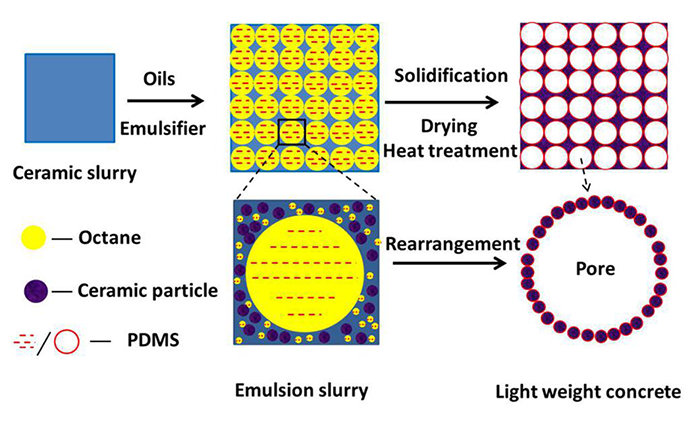 Sample preparation flow chart
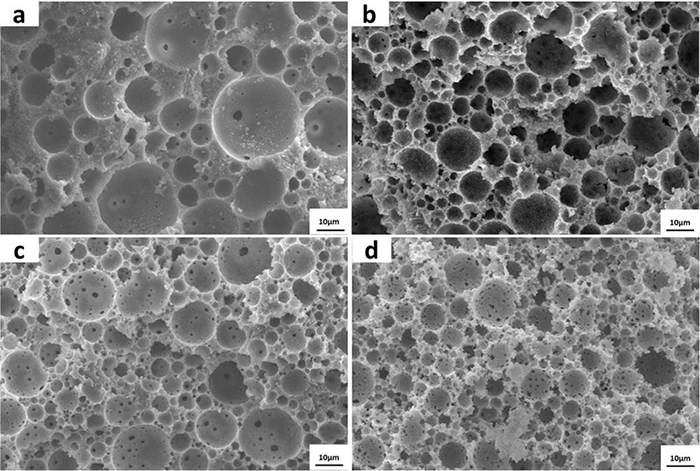
SEM of samples with different water oil ratio (a) 1:1, (b) 1:2, (c) 1:3, (d) 1:4
Due to the small particle size of the original powder, the heat treatment during the modification process makes the hydrophobic group uniformly cover the surface of the powder, and the water contact angle of the light concrete prepared can reach 166 °. The water drop on the surface of the sample will pop off rapidly, and the sample with density less than 1.0 g / cm3 can float on the water surface, even if the sample is immersed in the water, it will rise to the water surface rapidly.
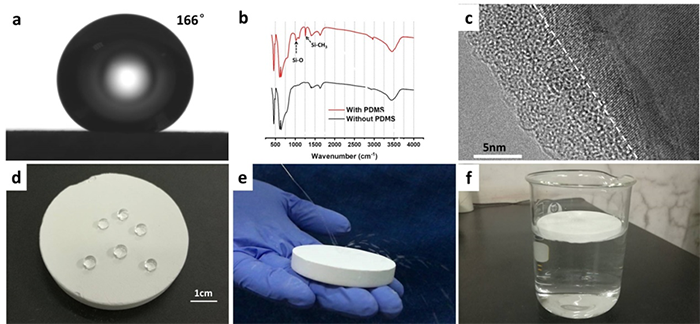
(a) water contact angle; (b) infrared spectrum of the sample; (c) TEM image; (d) state of the sample when the water contacts the sample; (E) the sample bounces off quickly on the water drop; (f) photo of the light sample floating on the water surface.
The super hydrophobic lightweight concrete can exclude dust particles and liquid, including milk, beer, soy sauce, coffee and dyed water, and can be soaked in the liquid without any stains. Even after mechanical wear, high temperature heat treatment and chemical corrosion, the material still maintains superhydrophobic properties. In addition, porous concrete can absorb noise and heat insulation, which are two other attractive characteristics of building materials.
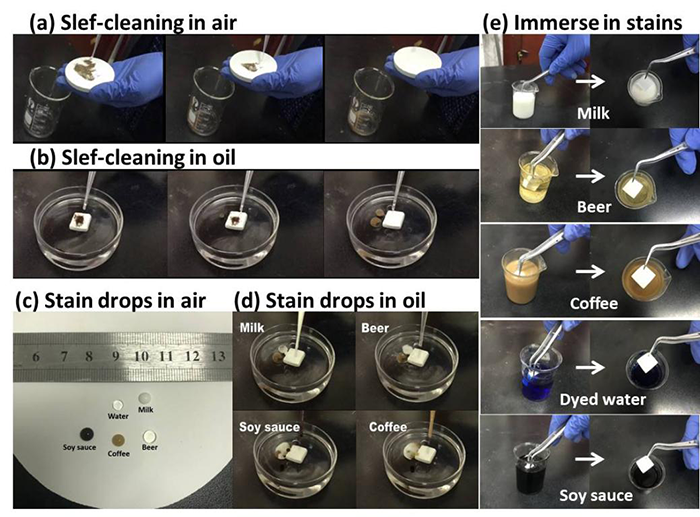
(a) air self-cleaning test. Dust particles are easily removed by water drops; (b) self cleaning experiment in oil. The dust particles (n-heptane) in the oil are easy to be taken away by water drops; (c) the spherical dye liquid will not be immersed on the surface of the material; (d) the dye liquid of the sample immersed in the oil will pop away quickly; (E) the sample is not stained after being immersed in the dye liquid and taken out.
Dong Binbin, a doctoral student in Professor Xu Xin's research group, is the first author of the paper. Professor Xu Xin is the corresponding author of the paper. This work is supported by the National Natural Science Foundation of China and the open fund of the State Key Laboratory of advanced refractories.
The results of this study were reported by ACS news service weekly presspac, Science Daily, international business times, interest engineering and other media. ACS magazine specially produced popular science videos for the work, and reproduced them on youtube and other video websites, and also promoted the official Chinese wechat.
Attached article link
HTTPS://pubs.acs.org//doi//abs//10.1021//acsami.9b14929
Original:ENGLISH
HTTPS:///www.acs.org///content//acs//en///pressroom///presspacs///2019//acs-presspac-November-20-2019///self-cleaning-concentre-could-keep-buildings-looking-new-video.html
Interesting Engineering.com//Researchers-Create-Self-Cleaning-Complete-that-Repels-Life
HTTPS:///www.sciencedaily.com///releases///2019///11///19120131321.htm
HTTPS://www.ibtimes.com//
HTTPS://MP.Weixin.qq.com///s//vt5rkbejsxo1iak0fhazjw