

He Junfeng's research group of the University of Science and Technology of China cooperated with counterparts at home and abroad to conduct research on spin-orbit-coupled Mott insulators and made important progress: The team used high-resolution angle-resolved photoelectron spectroscopy to first couple electron-doped spin-orbit Mott insulators (Sr2IrO4 ) Found direct experimental evidence of electron-boson coupling. The research results were published in the important international physics journal Physics Review Letters [Physical Review Letters 123, 216402 (2019)] on November 21, 2019.
Discovering and understanding the strange quantum phenomena produced by doped Mott insulators is a core issue in the study of condensed matter physics. A typical example of a doped Mott insulator is a copper oxide high temperature superconductor. In this system, three important quantum phenomena such as d-wave high-temperature superconductivity, chirped energy gap, and electron-boson coupling have been gradually discovered by experiments. Moreover, people are further aware of the close relationship between the three. For example: the chirped energy gap is closely related to d-wave superconductivity (whether as a possible competitor or a kind of pre-pairing); electron-boson coupling may provide the "glue" required for superconducting pairing; and recently The experiment proves that the electron-boson coupling is closely related to the chirp energy gap. Especially in the study of copper oxide high-temperature superconductor Bi2Sr2CaCu2O8 + σ, it was found that a positive feedback can be formed between the electron-boson (phonon) coupling and the chirp energy gap, and it is possible to further enhance d-wave superconductivity. In summary, the discovery and understanding of the chirped energy gap, d-wave superconductivity, and electron-boson coupling are crucial to the ultimate reveal of the physical laws in copper oxide high-temperature superconductors.
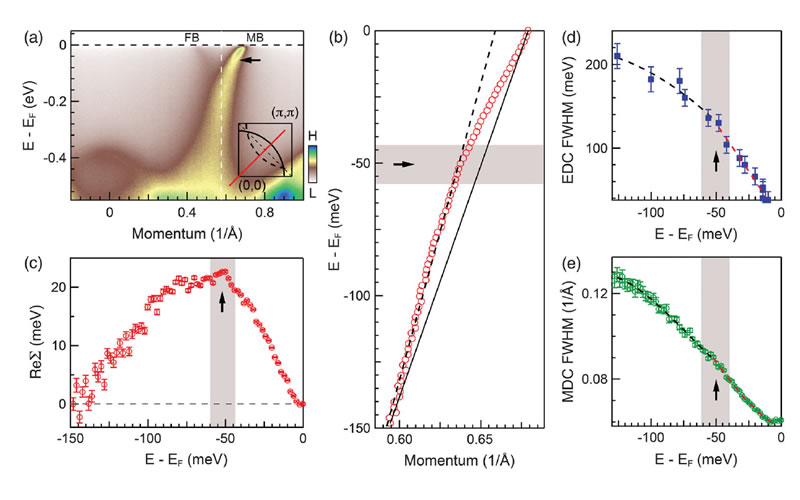
Figure: Photoelectron spectroscopy evidence of electron-boson coupling in electron-doped iridium oxide
Iridium oxide Sr2IrO4, as a typical spin-orbit-coupled Mott insulator, can theoretically be described by the same micromodel as a copper oxide high-temperature superconductor. Therefore, a very natural question is whether the strange quantum phenomena such as those exhibited in copper oxides can be found in the Sr2IrO4 system. In recent years, experiments have found similar erbium energy gaps and d-wave energy gaps in copper doped Sr2IrO4 systems. However, electron-boson coupling has not been discovered.
In this work, the research team of He Junfeng and his collaborators conducted a systematic study of electron-doped Sr2IrO4 using high-resolution angle-resolved photoelectron spectroscopy, and found that this third feature similar to copper oxide: electron-boson coupling . This latest discovery (shown in the figure) not only reveals another common physical property of iridium oxide and copper oxide, but also studies the core problems in doped Mott insulators: the chirp energy gap, the d-wave energy gap, and The relationship between the electron-boson coupling provides a new window.
The Chinese University of Science and Technology is the first unit of the thesis. Postdoctoral researcher Yong Yong from the Junfeng He group is the first author of the paper. Corresponding author. This work was supported by funding from the University of Science and Technology of China.
Attach article link: https://journals.aps.org/prl/abstract/10.1103/PhysRevLett.123.216402
(Hefei National Research Center for Microscale Physical Science, College of Physics, Chinese Academy of Sciences Key Laboratory of Strong Coupling Quantum Material Physics, Ministry of Scientific Research)